Cloudy glasses. White film on dishes. Gritty residue that won’t rinse away no matter how much detergent you use. If you’re dealing with hard water, your dishwasher is fighting a losing battle, and your dishes are paying the price. The good news? A water softener for dishwasher use can solve the problem without a whole-home plumbing overhaul. Many modern dishwashers with water softener capabilities come equipped with built-in systems, while older models can benefit from salt-based solutions or aftermarket treatments. Understanding how these systems work, and whether your machine already has one, can save you from rewashing loads and replacing etched glassware.
Table of Contents
ToggleKey Takeaways
- A dishwasher water softener uses ion-exchange technology to remove calcium and magnesium minerals, preventing cloudy glasses and chalky residue on dishes.
- Built-in water softener systems are the most convenient option and require only monthly salt refills, while older dishwashers can benefit from hard water boosters or aftermarket treatments.
- Signs of hard water damage include white film on glassware, scale buildup on heating elements, and reduced water flow from spray arms—addressing these early prevents irreversible etching.
- Always use coarse dishwasher salt, never table salt or rock salt, and maintain your softener by refilling every 1–3 months to keep the ion-exchange resin bed functioning properly.
- If your water hardness exceeds 7 gpg, investing in a dishwasher water softener solution—whether built-in, point-of-use, or whole-home—protects your appliance and dishes from mineral damage.
- Test your water hardness using an inexpensive test strip before purchasing; water below 3 gpg may only need quality detergent and rinse aid, while above 10 gpg requires active softening.
What Is a Dishwasher Water Softener and How Does It Work?
A dishwasher water softener is a built-in or aftermarket system that removes calcium and magnesium ions from your water supply before it reaches your dishes. Hard water contains dissolved minerals, typically measured in grains per gallon (gpg) or parts per million (ppm), that interfere with detergent performance and leave behind chalky deposits.
Most dishwashers with water softener units use an ion-exchange process. Inside the softener compartment sits a resin bed filled with tiny beads coated in sodium ions. When hard water passes through, calcium and magnesium ions stick to the resin, and sodium ions are released into the water. This “softened” water rinses cleaner and prevents scale buildup on heating elements and spray arms.
The resin bed doesn’t last forever. After repeated cycles, it becomes saturated with hardness minerals and needs regeneration. That’s where dishwasher salt comes in. Adding coarse-grain salt (sodium chloride) to the softener reservoir flushes the resin, stripping away calcium and magnesium and recharging it with fresh sodium ions. This process happens automatically in some models or requires manual refilling in others.
Not all dishwashers have this feature. Entry-level models often skip the built-in water softener dishwasher system to cut costs. If your machine doesn’t have a salt compartment (usually located at the bottom of the tub near the filter), you’re relying solely on detergent to combat hard water, and that’s rarely enough.
Signs Your Dishwasher Needs a Water Softener
Hard water damage shows up in predictable ways. Recognizing these symptoms early can prevent permanent etching on glassware and extend your dishwasher’s lifespan.
White film or cloudiness on glassware. This is calcium carbonate buildup. It starts as a faint haze and, over time, becomes a stubborn, etched finish that won’t wipe off. Once glass is etched, the damage is irreversible.
Chalky residue on dishes and silverware. If plates come out with a gritty, white coating, especially in crevices or on plastic items, you’re seeing mineral deposits. Detergent alone can’t dissolve these.
Scale buildup on the dishwasher interior. Check the heating element, spray arms, and door gasket. White or yellowish crust is a telltale sign. Scale reduces heating efficiency and can clog spray nozzles, leading to poor wash performance.
Detergent not dissolving properly. Hard water binds with detergent ingredients, forming soap scum instead of suds. You’ll burn through detergent faster and still get lackluster results.
Reduced water flow from spray arms. Mineral deposits can block the tiny holes in spray arms. If you notice weak spray patterns or dishes in certain rack positions coming out dirty, pull the arms and inspect the nozzles.
If you’re experiencing two or more of these issues, a dishwasher for hard water is worth considering, or you need to activate and maintain the softener system you already have.
Types of Water Softening Solutions for Dishwashers
Built-In Water Softener Systems
Many mid-range and high-end dishwashers come with integrated water softeners. Brands like Bosch, Miele, and Thermador commonly include this feature. The softener reservoir sits at the base of the tub, and you fill it with coarse dishwasher salt (not table salt, it contains anti-caking agents that damage the resin).
These systems have adjustable hardness settings, typically ranging from 0 to 10 or higher. You’ll need to test your water hardness using a test strip (available at hardware stores or through your municipal water report) to dial in the correct level. Setting it too low won’t soften effectively: too high wastes salt.
Built-in systems are the most convenient option. Once configured, they regenerate automatically between cycles. You only need to check the salt level every month or two, depending on usage and water hardness. A low-salt indicator light will alert you when it’s time to refill.
Salt-Based Dishwasher Softeners
If your dishwasher doesn’t have a built-in system, you can use salt-based additives or rinse aids designed for hard water. These aren’t true softeners, they don’t remove minerals, but they help detergents work better and reduce spotting.
Dishwasher salt additives are poured into the detergent compartment or prewash cup. They contain citric acid or other chelating agents that bind to hardness minerals, preventing them from depositing on dishes. Brands like Finish and Cascade make hard water boosters.
Rinse aids with water softening agents improve drying and reduce water spots. They lower the surface tension of water, helping it sheet off dishes instead of beading up and leaving mineral rings. Use these along with a booster for best results.
Another option: install a whole-home water softener. This treats all water entering your house, benefiting your dishwasher, washing machine, and plumbing fixtures. It’s a bigger investment, typically $800 to $2,500 installed, but it solves hard water issues across the board. Homeowners considering this route should compare local contractor pricing to get a realistic budget.
For renters or those on a budget, portable under-sink water softeners can be installed on the dishwasher supply line. These compact units use salt or potassium chloride cartridges and don’t require professional installation. They’re less common but effective for targeted treatment.
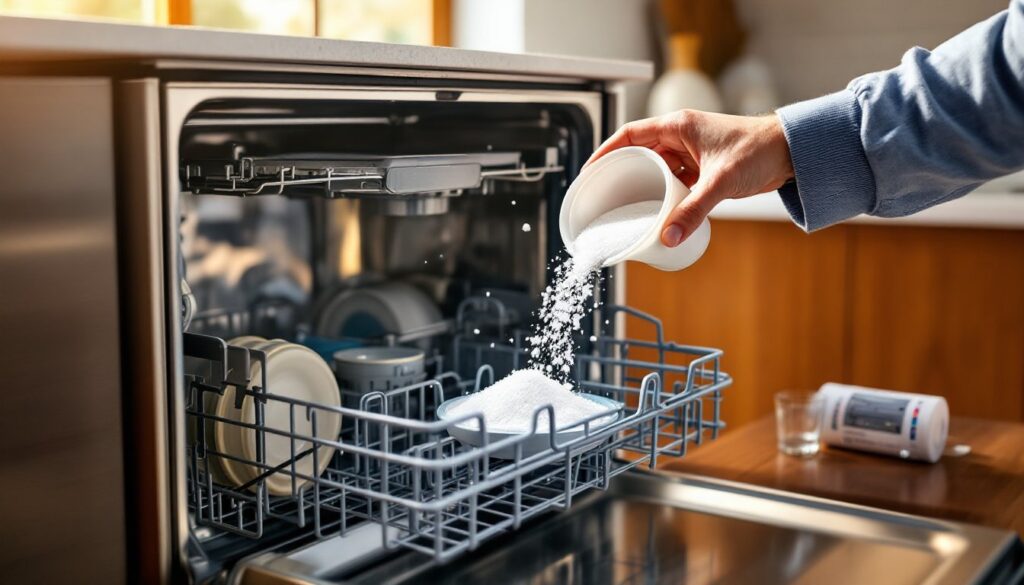
How to Add Salt to Your Dishwasher’s Water Softener
If your machine has a built-in water softener, keeping it filled with salt is non-negotiable for performance. Here’s how to do it properly.
1. Locate the salt reservoir. It’s usually a screw-top cap at the bottom of the dishwasher tub, near the filter basket. Some models have a clearly labeled “Salt” icon: others don’t. Check your owner’s manual if you’re unsure.
2. Unscrew the cap and check for water. The first time you fill the reservoir, it should be filled with water up to the threads. This is normal. On subsequent refills, you’ll add salt directly into the existing brine solution.
3. Use coarse dishwasher salt only. Table salt, rock salt, and water softener pellets are not suitable. Dishwasher salt is pure sodium chloride with large, slow-dissolving granules. It won’t clog the system or leave residue.
4. Pour salt into the reservoir using a funnel. Fill it until the salt reaches just below the threads, typically 1 to 2 pounds depending on the model. Don’t overfill: this can interfere with the cap seal.
5. Wipe away any spilled salt. Loose grains left in the tub can scratch dishes or corrode the stainless steel lining over time.
6. Screw the cap back on tightly. Run a rinse cycle or start a normal load. The dishwasher will dissolve the salt into a brine solution and use it to regenerate the resin bed.
7. Set the water hardness level. Most dishwashers have an electronic control or manual dial to adjust softener intensity. Test your water hardness with a strip (measured in gpg or °dH), then consult your manual to match the setting. Water above 7 gpg is considered hard: above 10 gpg is very hard.
Refill the salt reservoir when the indicator light comes on or every 1–3 months, depending on usage. Regular maintenance of this component is one of the simplest ways to keep your dishwasher running efficiently.
Choosing the Right Water Softener for Your Dishwasher
Your decision hinges on three factors: your dishwasher’s capabilities, your water hardness level, and your budget.
If you’re buying a new dishwasher, prioritize models with built-in water softener dishwasher systems if your water exceeds 7 gpg hardness. Bosch 300 Series and higher include this feature: Miele and KitchenAid offer it on select models. Expect to pay $600 to $1,200 for a dishwasher with this capability.
If you already own a dishwasher without a softener, start with a hard water detergent booster. Products like Lemi Shine or Finish Hard Water Booster run $8 to $12 for a month’s supply. Pair it with a quality rinse aid to minimize spotting.
For extreme hardness (12+ gpg), consider a point-of-use water softener installed on the dishwasher’s supply line. Models from brands like Watts or Aquasana cost $150 to $300 and require cartridge replacement every 6–12 months. Installation is straightforward, shut off the water, disconnect the supply line, thread in the softener unit, and reconnect. No soldering or special tools needed.
Whole-home softeners make sense if you’re also dealing with scale in showers, water heaters, and faucets. Salt-based systems are the gold standard, removing hardness at the source. Budget $1,000 to $2,500 for the unit and professional installation. For DIY-friendly alternatives and project walkthroughs, resources like Family Handyman offer step-by-step guides.
Salt vs. salt-free systems: Traditional ion-exchange softeners (salt-based) remove hardness minerals. Salt-free conditioners use template-assisted crystallization (TAC) to alter mineral structure, preventing scale but not actually softening water. For dishwashers, ion-exchange is more effective.
Maintenance costs: Built-in dishwasher softeners cost $15 to $30 per year in salt. Whole-home systems use 40–80 pounds of salt monthly, running $5 to $10 per bag. Factor in these ongoing expenses when comparing options.
Test your water hardness before making any purchase. If your municipal supply is under 3 gpg, you may not need a softener at all, just a good detergent and rinse aid. Above 7 gpg, a water softener dishwasher solution becomes essential for long-term appliance health and spot-free results.